Подорож довжиною в горювання
A grieving long journey
розділ 2 · chapter 2
«У тих народів, до яких я належу – у мад'яр та мексиканців – прийнято розповідати історії, займаючись
повсякденними справами. Що таке життя і чому воно вчить – на ці питання, які виходять із самої глибини
серця, частіше за все відповідають історією або одразу декількома. Казки для нас – що друзі чи родичі. Як
запрошують друга приєднатися до розмови, так і одна історія тягне за собою другу, а та в свою чергу – третю,
а буває і четверту, і п’яту, і ще, і ще, поки відповідь на задане питання не стане довжиною в цілий епос.»
— Естес Клариса Пінколь, "Вірний садівник"
«Let your heart break, And let a story appear...»
— Pema Chödrön
“Among my people – Hungarians and Mexicans – there is a tradition of telling stories performing daily
activities. What life is and what it teaches us – these questions that come from the very depth of the heart
are often answered with a story or several stories at once. Fairy tales are like friends or relatives to us.
Just like a friend is invited to join a conversation, one story evokes another story, and then the third and
sometimes the fourth and the fifth one, more and more until the answer to the question becomes many stories
long.”
— Clarissa Pinkola Estes, “A Faithful Gardener”
розділ 3 · chapter 3
Сьогодні я просто хочу розповісти Вам декілька історій, які трапились зі мною, з нами, з
моїми клієнтами, які погодились на те, щоб я їх розповіла упродовж майже 20 місяців війни. Звісно ж ці
історії пов’язані між собою, але іноді цей зв’язок не так легко побачити. Як і в епіграфі одна історія
тягне за собою іншу. І ще, і ще. Я сподіваюсь, що у вас в голові теж будуть виникати історії і ви будете
мати змогу їх сьогодні розповісти, або написати нам потім.
Today, I just want to tell you a few stories that happened to me, to us, to my clients, who
gave me their permission to share the stories, during almost 20 months of war. Of course these stories
are interconnected, but sometimes it’s not so easy to see this connection. Like in the epigraph, one
story evokes another story, and then another, and another. I hope that some stories will also come to
your mind, and you will have an opportunity to tell them today or send to us later.
розділ 4 · chapter 4
Ми живемо на розломі. Наша трансцендентна функція напружена як ніколи. І одне з того, що
допомагає справлятися – це наша здатність до ампліфікації або символізації. Слухання та розповідання
історій допомагає нам, мені в процесі саморегуляції
We live on a fault line. Our transcendental function is tense as never before. And one of
the things that help to cope is our ability to amplify or symbolize. Listening and telling stories helps
us, helps me in the process of self-regulation.
розділ 5 · chapter 5
В ситуації такої напруги нам дуже потрібно відчути, що у нас є вибір та вбачати цей вибір.
Це допомагає повернути відчуття власної цінності та значущості ,та відновити зв’язок з власною Самістю.
Відчути цей вибір та відновити зв’язок із самим собою допомагають нам історії. Ці різні історії
допомагають різним нам у процесі само- та со -регуляції. Що у свою чергу допомагає відчути цей вибір та
відновити зв’язок. Розповідання та слухання історій дозволяє нам зустрітися з Іншим всередині себе. Воно
заспокоює або надихає, сприяючи таким чином саморегуляції та со-регуляції з Іншим. І це дуже знайомий
усім нам процес, бо зазвичай клієнти розповідають нам історії, а ми – в свою чергу, – намагаємось їх
почути.
In the situation of such tension we really need to feel that we have a choice, and to see
this choice. It’ll help bring back the sense self-value and significance, and renew the connection to
one’s Self. Stories help us feel this choice and renew the connection to ourselves… These different
stories help different us in the process of self- and co-regulation. And in turn, this helps us feel the
choice and renew the connection. Telling and listening to stories helps us meet the Other inside
ourselves. It soothes or inspires, this way facilitating self-regulation and co-regulation with the
Other. And this is the process that we all know quite well, because usually clients are telling us
stories and we, in our turn, are trying to hear them.
розділ 6 · chapter 6
Коли влітку 2022 я знаходилась у Німеччині та переживала втрату Домівки та смерть матері,
яка трапилася за моєї відсутності, мені запропонували прийняти участь у перекладі статті Верени Каст, я,
звісно, не могла і уявити, що через 1.5 року мені трапиться нагода вести разом семінар.
When I was in Germany in the summer of 2022 and I was experiencing the loss of Home and the
death of my mother that happened when I was away, I was offered to participate in the translation of
Verena Kast's article. Naturally, I couldn't even imagine that a year and a half later I'd have an
opportunity to lead a seminar together.
розділ 7 · chapter 7
Робота над статтею дуже допомогла мені в моєму власному процесі горювання. На той момент я
знаходилась у глибокій депресії, з якої не могла знайти вихід мабуть саме тому, що моя Самість стосунків
була достатньо розвинутою на відміну від власної Самості, контакт з якою був ослабленим. Розуміння цього
допомогло мені прийняти певні рішення, які я і досі вважаю важливими у моєму житті. Зголоситися прийняти
участь у проекті «З українськими юнгіанцями» мене надихнула саме бажання відновити цей зв’язок з моєю
власною Самістю.
Working on the article helped me in my own grieving process. At that moment I was deeply
depressed and I couldn't find a way out of it, and maybe the reason was that my relational Self was
quite developed, unlike my individual Self, the contact with which became weaker. Understanding this
helped me to make certain decisions that I still consider to be important in my life. It was this desire
to restore the connection to my own Self that inspired me to agree to participate in the project “With
Ukrainian Jungians”.
розділ 8 · chapter 8
Завдяки ініціативі Центру досліджень символів ARAS, щодо можливості ділитися образами, у
мене миттєво у голові стали з’являтися образи один за одним, які виникали під час війни у колективному
полі. Така проста, дуже юнґанська і насправді ґеніальна ідея, – якщо бракує слів, то на допомогу
приходять образи. Думаю, що вони добре знайомі більшості українців. Саме ці образи, які зустрілися мені
на теренах війни, які стали для мене символами прощання та горювання по своєму минулому безтурботному
життю та фантазіям безсмертя, асоціюються у мене з втратою та горюванням. І сьогодні я хочу розділити
своє горе з Вами і сподіваюся, що у Вас також буде така можливість: розділити своє горе зі мною, з нами
усіма, бо ми разом.
Due to the initiative of the Archive for Research in Archetypal Symbolism (ARAS) concerning
the possibility to share symbols – immediately images began to come to my mind one after another; these
images appeared during the war in the collective field. Such a simple, very Jungian and really genius
idea – if you lack words, the images will come to your aid. I think that the majority of Ukrainians know
them quite well. These particular images that I came across on the terrain of war and that became the
symbols of farewell and grieving for my past carefree life, for fantasies of immortality are associated
with loss and grieving for me. And today I want to share my grief with you and hope that you will also
have the opportunity to share your grief with me, with all of us, because we are together.
розділ 9 · chapter 9
Колись я навчалась груповому аналізу в Австрії і там була жінка, групова аналітикиня з
Німеччини, яка стала для мене символічною матусею. Вона полюбляла носили різні шалі. І після цього я теж
почала полюбляти носити шалі. І у мене їх дуже багато. Коли я втекла від війни до Німеччини, то полишила
все вдома і звісно ж не змогла потім навесні попіклуватися про них. І багато з них поїла моль. Майже всі
мої самі улюблені. І коли я повернулась і виявила це, то була дуже засмучена. Деякі дірки я зашила або
приховала, але не усюди це вдалося. І деякі шалі я продовжую носити з цими дірками. Це так, ніби
продовжувати жити з втратами.
When I was studying group analysis in Austria there was a woman, a group analyst from
Germany, who became a symbolic mother to me. She liked wearing different shawls. After that I also began
to enjoy wearing shawls. I have quite a lot of them. When I escaped from the war to Germany, I left
everything at home, and in the spring I wasn’t able to take care of the shawls and many of them were
eaten by moth. Almost all of my favourite ones. When I came back and discovered it I was very upset.
Some of the holes I mended or hid, but I couldn’t do it everywhere. I continue wearing some of the
shawls with these holes. It is like one continues living with losses.
розділ 10 · chapter 10
Такі самі дірки, як на моїх шалях залишаються і в Душі людини після травми горювання. Коли
Людина потрапляє у такі пусті місця, вона ніби помирає, як котик в дитячому ліжку із історії, якою зі
мною поділилася моя клієнтка. Котик, якого полишили вдома самого і який помер у дитячій колисці від
смутку та самотності. На початку війни ми чули багато історій, коли люди відмовлялися виїздити та
залишати своїх улюбленців вдома. Але іноді траплялося і таке, що люди в паніці швидко виїздили з дому та
полишали тварин з різних причин. Насправді важко уявити собі справжнього котика, який ляже і буде
помирати від горя. Але ми можемо собі уявити, що так може почувати себе людина, коли її покинули. Саме
цей образ асоціюється у мене з почуттями покинутості, самотності, зрадженості та горя від втрати надії.
The same holes like in my shawls remain in the Soul of a person after the trauma of
grieving. When someone gets into such empty places, it is akin to dying, like the cat in the crib from
the story that my client shared with me. The cat that was left home alone and died in the child’s crib
from sadness and loneliness. At the beginning of the war we heard a lot of stories when people refused
to leave without their pets. But sometimes it happened that people left in panic and for various reasons
didn’t take their pets with them. It was told to me as a true story, but the picture I found on internet
was a drawing. Because it is really hard to imagine a real cat who would lie down and die of sorrow. But
we can imagine that a human being could feel like that being abandoned. This particular image is
associated for me with feelings of abandonment, loneliness, betrayal and grief caused by the loss of
hope.
розділ 11 · chapter 11
Але також ця історія одночасно може бути символом сепарації та втрати дитячої невинності,
розставанням з інфантильною дитячою вірою в те, що наші батьки завжди прийдуть нам на допомогу та
візьмуть на ручки та врятують нас. Мушу сказати, що на початку війни я теж дуже чекала на те, що зараз
хтось прийде і врятує нас. Хтось сильний і добрий. І коли зрозуміла, що ніхто не прийде і не врятує, я
поїхала з України. Потім все ж таки повернулась, але це вже інша історія.
And at the same time it can be the symbol of separation and of the loss of childhood
innocence; renunciation of the infantile faith that our parents will always be there for us, that they
will hold us and save us. I have to say that at the beginning of the war I was also waiting for somebody
to come and save us. Somebody strong and kind. And when I realized that nobody would come, I left
Ukraine. Later on I did come back, but it’s already a different story.
розділ 12 · chapter 12
Або якщо Душа Людини все ж таки виживає, вона дуже страждає, як Пес Крим з Дніпра. Це
справжня історія, яка відбулася в ніч з 28 на 29 вересня 2022 року, коли російська ракета влучила у
будинок в Дніпрі, в якому загинула вся сім’я: мама, бабуся та двоє дітей: хлопчик та дівчинка.
Рятувальники знайшли тільки пса на ім’я Крим, який скиглив на попелищі та не хотів зрушувати з місця.
Він один вцілів і плакав від горя. Цей пес став для багатьох і для мене також, символом горювання та
втрати. Рятувальники виявили у пса серцеву недостатність. Його лікували, але він таки помер від горя.
Or when the Soul of a Person survives after all, it suffers a lot, like the Dog Krym from
Dnipro. This is a true story that happened in the night from September 28 to September 29 in 2022 when a
Russian missile struck a residential building in Dnipro and the whole family was killed: the mother,
grandmother and two children: a boy and a girl. The rescue team found only the dog named Krym who was
howling on top of the ruins and didn’t want to leave. He was the only one who survived and was crying
with grief. For me and many others this dog became the symbol of grieving and loss. The rescuers
discovered that the dog had heart failure. He was treated but he nevertheless died of grief.
розділ 13 · chapter 13
Але весь час залишається надія, що Душа людини потім відродиться, як птах Фенікс з історії
про кота, якого потім назвали вже Феніксом. Це кіт із вщент зруйнованого та спаленого селища Авдіївка
Київської області. Кіт суттєво постраждав – мав опіки на тілі, обпалену шерсть та вуса. Але завдяки
турботі колективу магазина Pethouse він вижив, його рани загоїлись і він продовжив жити. Але він ніколи
не забуде того, що сталося і ніколи вже не буде таким, як був. Він наче птиця Фенікс повстав з попелища
та відродився до життя: обгорілий, понівечений але не скоре ний.
But the whole time the hope remains that the Soul of the person will rise again like the
bird Phoenix from the story about the cat who was later named Phoenix. This is the cat from Avdiivka
town in Kyiv region that was destroyed and burned to the ground. The cat was considerably injured: had
burns on the body, his fur and whiskers were burnt. But thanks to the care of the Pethouse shop staff he
survived, his wounds healed and he continued living, but he will never forget what happened and he will
never be the way he used to be. He, like the bird Phoenix, rose from the ashes and returned to life,
burnt, injured but not defeated.
розділ 14 · chapter 14
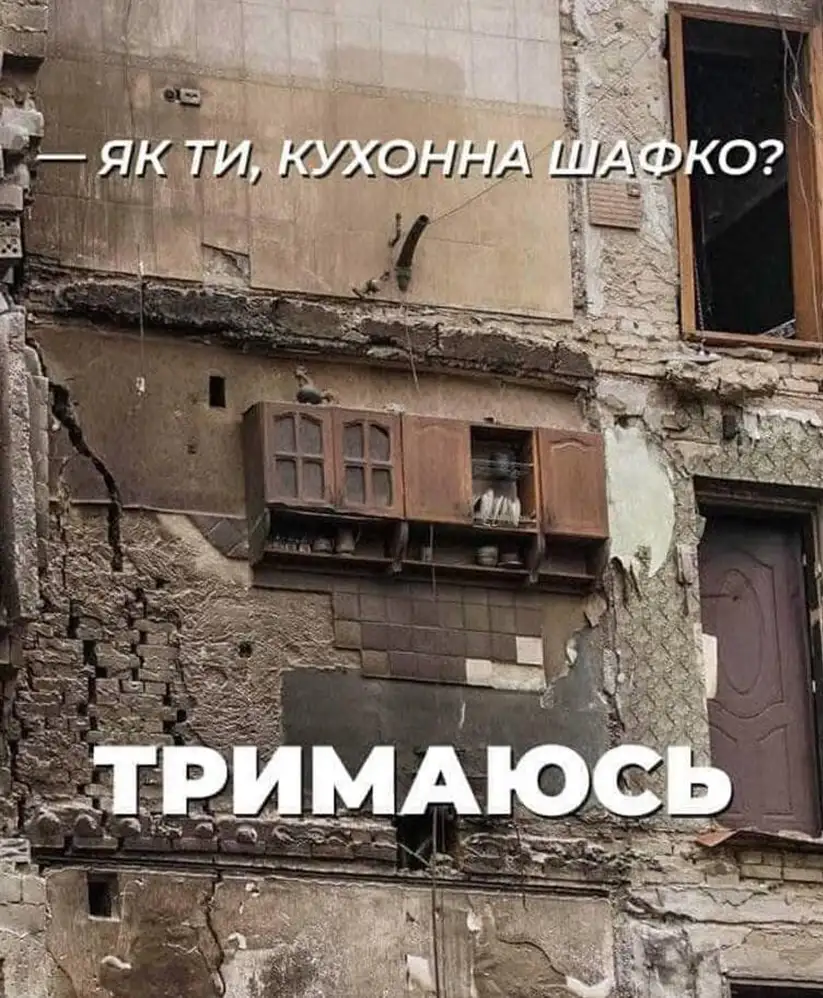
How are you, kitchen cupboard?
Hanging in there.
Hanging in there.
розділ 15 · chapter 15
Всім українцям знайомий позивний та відгук. З самого початку повномасштабної війни в
Україні ми починали будь-яке своє спілкування з питання: Як ти? І частіше чули у відповідь: тримаюсь. А
трошки пізніше з’явився цей образ Шафки, яка уціліла після бомбардування в зруйнованому будинку у с.
Бородянка.
All Ukrainians know this call and response. From the very beginning of the full scale war
in Ukraine we started every communication with the question: “How are you?” and more often we heard in
response: “Hanging in there”. And a little later this image of the Kitchen Cupboard appeared that
survived in the destroyed building after the bombing in Borodianka settlement.
розділ 16 · chapter 16
Поступово у нас накопичилась ціла колекція таких різних вцілілих шафок або фрагментів
будівель, які були зруйновані. Як символ нашого вцілілого життя поряд з зруйнованим. І на місці цих
«дірок» народ почав створювати творчі артефакти або творчі об’єкти – сучасна народна творчість. – ніби
латаючи ці дірки: від дуже простих у вигляді мемів, фотографій, малюнків або казок чи невеличких
оповідань до дуже складних насправді витворів мистецтва, які ви бачили сьогодні на самому початку нашого
вебінару. Люди збирають ці історії, розповідають їх, ілюструють.
Gradually we accumulated a whole collection of different surviving cupboards or fragments
of buildings that had been destroyed. As a symbol of our life that has survived alongside the one that
has been destroyed. And in the place of these “holes” people began to make creative artifacts or
creative objects – contemporary folk creativity, – as if mending the holes: from very simple ones, like
memes, photos, drawings or fairy-tales and short stories to very sophisticated real art masterpieces
that you saw today at the very beginning of our webinar. People collect these stories, tell them, and
illustrate them.
розділ 17 · chapter 17
Котик, Півник та Шафка – це оповідання Олександра Михеда. Це історія однієї сім’ї, яка
починається ще у роки Другої Світової війни і сягає війни сьогоднішньої. «Котик, Півник і Шафка наче й
казкові, але водночас і дуже справжні – врятовані і збережені у зруйнованій російськими обстрілами Бородянці
під Києвом. Готові боротися і попереджати про небезпеку, у цій казці вони оберігають Всесвіт однієї родини –
бабусі Лізи, дядька Андрія і онуки Соні – родини, яка покоління за поколінням циклічно проживає історію і
врешті стає сильнішою, ніж будь-коли. Нагріта теплом дідусевих рук Шафка, подарований на свято Півник і
врятований котик втілюють силу і незламність, бережуть рід і дарують надію. Це надія на майбутнє, у якому
рани будуть заліковані, але пам’ять про скоєне зло житиме у віках. У майбутньому, після нашої перемоги.»
The Cat, the Rooster, and the Cupboard is a story by Olexandr Mikhed. This is a history of
one family that begins during World War Two and reaches today’s war. “The Cat, the Rooster, and the Cupboard
are like fairy tale characters, but at the same time, very real – they were rescued and preserved in an
almost destroyed by Russian shelling Borodianka near Kyiv. Ready to fight and warn of danger, in this fairy
tale, they protect the universe of one family – grandmother Liza, uncle Andrii and granddaughter Sonia – a
family that cycles through history from generation to generation and, in the end, becomes stronger than
ever. The Cupboard, warmed by the warmth of grandfather's hands, the Rooster, that was given as a holiday
present, and the rescued Cat embody strength and invincibility, protect the family and give hope. This is
hope for the future, in which the wounds will be healed, but the memory of the evil committed will live
through the ages. In the future, after our victory”.
розділ 18 · chapter 18
На багатьох малюнках Душі загиблих тварин або дітей намальовані блакитними фарбами – це як
символ відродження Душі. Тварини символізують природу людини, почуття, чутливість. Собака, який вижив,
коли людське помирає. Бо під час війни людське помирає. Залишається природне. Кіт Фенікс пройшов
випробування вогнем, але потім відродився.
In many pictures The Souls of perished animals or children are painted with blue colours –
as a symbol of the rebirth of the Soul. Animals symbolize the nature of a human being, feelings,
sensitivity. The dog who survived when what is human dies. Because during the war the human dies. The
natural remains. When the cat Phoenix went through the test of fire, but then rose again.
розділ 19 · chapter 19
Півень це зовсім інша істота. У цьому оповіданні він символізує внутрішній наш голос, який
має попереджати про небезпеку. Але він занадто довго не використовувався, тому не зміг. Бо у цій родині
не любили змін. Але водночас саме Півень сповіщає нас, що навіть самій темній ночі приходить кінець.
The rooster is a totally different creature. In this story he symbolizes our inner voice
that has to warn us of danger. But he hadn’t been used for such a long time and hence he wasn’t able to
do it. Because in this family they didn’t like change. But at the same time it is the Rooster who
informs us that even the darkest night ends.
розділ 20 · chapter 20
Він символізує Меркурія, який рухається, змінюється, руйнує та відроджується. Меркурій –
майстер змін та гумору. На відміну від Шафки, яка тримається та залишається незмінною. Ми ніби
балансуємо між усвідомленням повної руйнації нашого життя та спробами все/хоча б щось залишити таким як
було; між необхідністю змін та потребою у стабільності. Жахливий реальний процес трансформації, який
відбувається саме зараз з нами усіма.
He symbolizes Mercury, that moves, changes, destroys and gets reborn. Mercury is a master
of change and humour. Unlike the Cupboard that hangs in there, remaining immutable. As if we balance
between the awareness of total destruction of our life and our attempts to make sure that everything/at
least something stays the way it used to be; between the necessity for change and the need for
stability. A horrible real process of transformation that is happening with all of us right now.
розділ 21 · chapter 21
І на останок ще трошки про Відьом. Я була дуже здивована спочатку, коли на свій заклик
надіслати образи, які символізують для Вас процес горювання, я отримала велику кількість пісень, кліпів,
малюнків і історій про Відьом. «Буде тобі, враже, так, як Відьма скаже».
And a little more about Witches. First I was very surprised when to my invitation to send
images associated with the process of grieving, I received a lot of songs, videos, drawings, and stories
about Witches. “Whatever the witch says, will happen to you, enemy”.
розділ 22 · chapter 22
Мої зустрічі з Вереною та з моїм супервізором Мартином Скала допомогли мені краще
зрозуміти, як це пов’язано з процесом горювання. Як безпомічність, безпорадність перетворюються на
всемогутність, силу та відсутність жалю. Бо часто відьма насправді та, хто багато втратив, іноді все.
Тому нічого більше не боїться. У кожної конкретної Відьми є своя власна історія. І зазвичай вона про
втрати. І самою останньою втратою є втрата віри. Віри в справедливість насамперед. В певному сенсі ми
можемо уявити, що в кожній українці живе зараз або прокидається час від часу така Відьма. Або навіть, що
вся Україна перетворюється час від часу на Відьму. Коли ми вже перетворюємось на Відьму, то впізнати в
ній того, хто захищається важко.
My meetings with Verena and my supervisor, Martin Skala, helped me understand how it was
connected with the grieving process. How helplessness turns into omnipotence, power and mercilessness.
Because a witch is the one who has actually lost a lot, sometimes everything. And that’s why she is not
afraid of anything anymore. Every Witch has her own story; and usually it is about losses. And the final
loss is the loss of faith; first of all the faith in justice. In a certain sense we can imagine that
such a Witch either lives or wakes up from time to time in every Ukrainian woman now. Or that the whole
of Ukraine is a Witch in a way. And once we turn into a Witch it is difficult to recognize in her the
one who is protecting herself.
розділ 23 · chapter 23
Таким прикладом знайомої нам всім історії перетворення на Відьму є історія Деметри, коли
Аїд вкрав у неї доньку, а Зевс її зрадив. Деметра була дуже обурена такою подвійною зрадою. Одягнена в
темний одяг, дев'ять днів, нічого не усвідомлюючи, ні про що не думаючи, блукала велика богиня Деметра
по землі, проливаючи сльози. Вона занурилася у себе та припинила давати любов та тепло назовні. І світ
занурився у депресію. Завмерло життя на землі, земля припинила родити, голод запанував усюди. Довго так
блукала Деметра, і ніщо не могло її втішити.
An example of turning into a Witch that we all know is the story of Demeter, when Hades
abducted her daughter, and Zeus betrayed her. Demeter was infuriated by such double betrayal. For nine
days, dressed in dark clothes, being unaware, not thinking about anything, the great goddess Demeter was
roaming the earth shedding tears. She withdrew and stopped giving love and warmth to the outside. And
the world sunk into depression. Life on earth stood still, the land became barren, and famine ravaged
the earth. Demeter was wandering like that for a long time and nothing could console her.
розділ 24 · chapter 24
Нарешті прийшла Деметра у вигляді старої жінки до міста Елевсину. Спочатку вона хотіла
зробити безсмертним сина короля Демофонта, загортаючи його вогнем. Але королева побачила і не дозволила
Деметрі робити це з її сином. Королева була лише людиною, тому трансформація вогнем була для неї
нестерпною. Бо трансформація вогнем-війною нестерпна для людини.
Finally, Demeter came to the city of Eleusis disguised as an old woman. First, she wanted
to make the king’s son Demophon immortal by wrapping him with fire. But the queen saw that and didn’t
allow Demeter to do it to her son. The queen was only human, hence the transformation through fire was
unbearable to her. Because the transformation through fire-war is unbearable for a human being.
розділ 25 · chapter 25
Зробити сина царя безсмертним через вогонь було спочатку нелюдською стратегією. Тоді
Деметра вигадала трансформацію через відродження пшениці. І це було вже таким, що можна винести. Деметра
навчила другого сина царя Келея Триптолема обробляти землю. І в такий спосіб дала нам надію на
відновлення.
To make the king’s son immortal through fire was an inhuman strategy to begin with. Then
Demeter came up with the idea of transformation through the revival of wheat. And that was something
that one could bear. Demeter taught another son of Celeus, Triptolemus, to cultivate soil. This way she
gave us hope for renewal.
розділ 26 · chapter 26
Деметра архетипова фігура. А Королева така людська, для якої нестерпним є буквальна
трансформація вогнем, але цілком прийнятна символічна трансформація. Я сподіваюся, що і ми, кожен з нас
також знайде свій спосіб відновитися.
Demeter is an archetypal figure. And the queen is so human that for her the literal
transformation through fire is unbearable, but the symbolic transformation is totally acceptable. I hope
that we, each of us, will also find our own way of renewal.
розділ 27 · chapter 27
Тут мала бути символічна інтерпретація, але зараз у мене з цим скрутно. Вийшло якесь
моралізаторство, а воно зараз ні до чого. Коли знаходишся у реальній небезпеці, то іноді важко
символізувати. Богиня запропонувала нам два способи відновлення або зберігання себе. Перший – це відновлення
через набуття безсмертя. “Герої не вмирають”, – часто чуємо ми. “Ще й як вмирають, вже дуже багато вмерло” –
лунає у відповідь. Другий – це відновлення через відродження. Саме тут з'явилося моралізаторство, тому
залишу поки що без відповіді. Мабуть тут має бути щось про Любов, про те, що ніколи не вмирає, про маленьку
ялинку, яка хотіла побачити світ та бути корисною.
There was supposed to be a symbolic interpretation here, but it's not easy for me at the
moment. It sounded like moralizing, but there is no need for that now. When you are in real danger, it
becomes difficult to symbolize. The goddess offered us two ways of renewal or preservation of ourselves. The
first one is the renewal through gaining immortality. “Heroes don't die” – we often hear. “They do die, so
many have died already” – comes the response. The second one is the renewal through revival. This is where
moralizing appeared, so for now I’ll leave it without an answer. Maybe there should be something here about
Love, about that which can never die, about a small fir-tree that wanted to see the world and be useful.
розділ 28 · chapter 28
Дуже дякую всім Вам за увагу та за внесок кожного присутнього тут в нашу перемогу. Дякую
Збройним силам України за можливість жити та виступати тут.
I am very grateful to everyone for your attention and for the contribution of each person
present here to our victory. I am grateful to the Armed Forces of Ukraine for making it possible to live
and speak here.
зцілення в історіях · healing in stories
Натискаючи «Прийняти cookie», ви погоджуєтеся на збереження файлів cookie на вашому пристрої для покращення навігації по сайту, аналізу використання сайту та допомоги у наших маркетингових зусиллях.